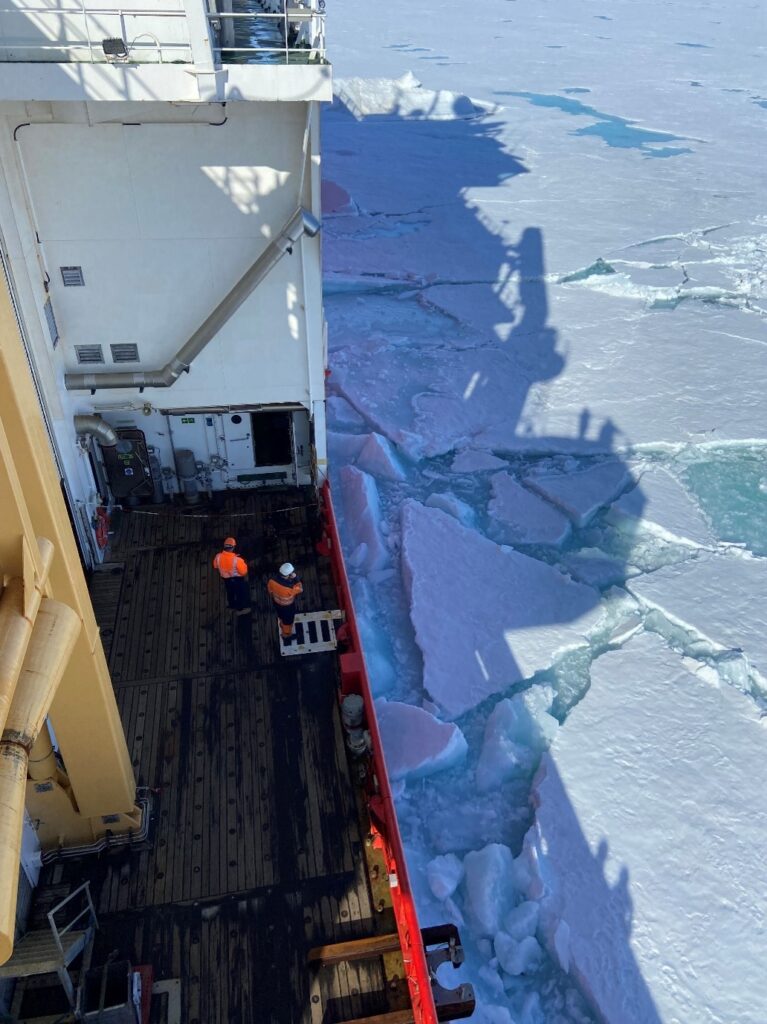
This summer I joined a group of over 40 scientists and support staff on a scientific cruise aboard the RRS Sir David Attenborough to the shelf and fjords surrounding Kangerlussuaq fjord in south east Greenland. The 3 year project aims to gather data on modern day oceanography and primary productivity in Greenland’s coastal seas, and collect marine sediment cores alongside terrestrial rock samples to reconstruct past glacier thickness and extent.
I have been working with the marine sedimentology team collecting sediment cores of up to 10 m from the seafloor in the fjords and shelf sea surrounding the Kangerlussuaq area. Sediment is continuously being deposited on the seafloor, trapping a snapshot of the biological, geochemical and sedimentological condition at the time of deposition. We can use these signals preserved in this mud to work out how the oceans near Greenland have affected the ice sheets in the past, and in turn how fresh melt water from melting glaciers has changed the oceans and our climate.
Working on the ship
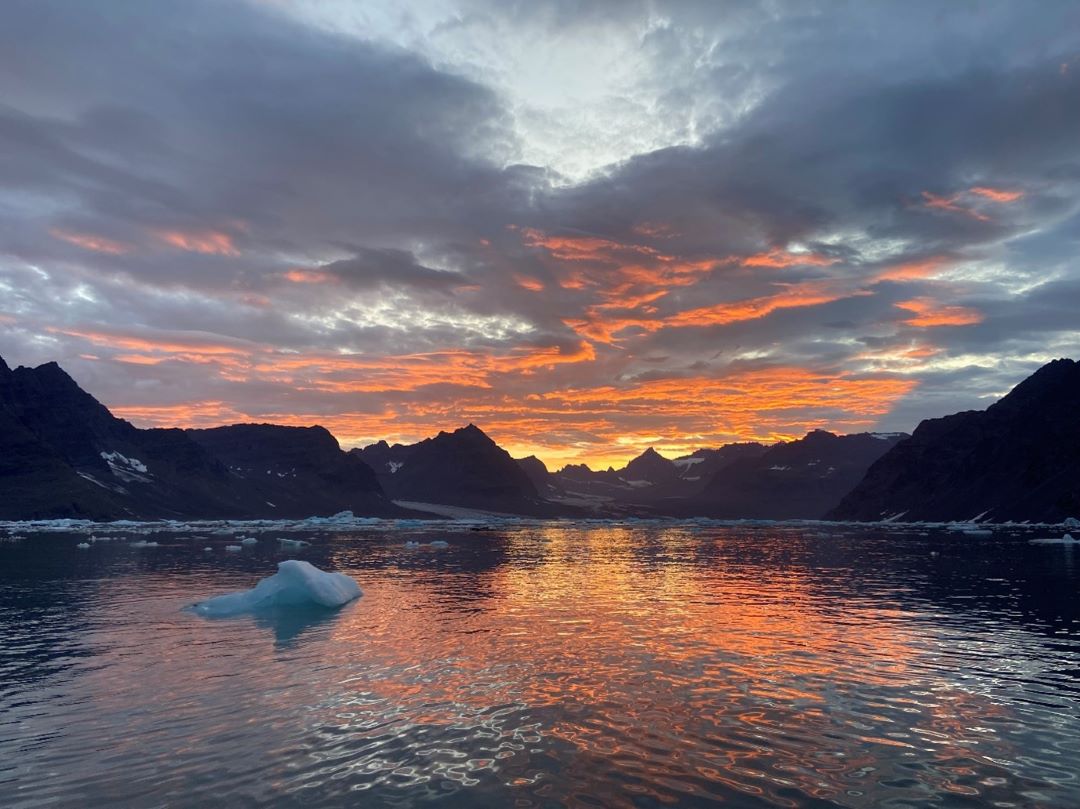
We work 12 hour shifts from 8 to 8 with people working 24 hours of the day. My team were on night shift from 8pm to 8am enjoying the arctic midnight sun and some beautiful sunsets and sunrises (sometimes only an hour apart).
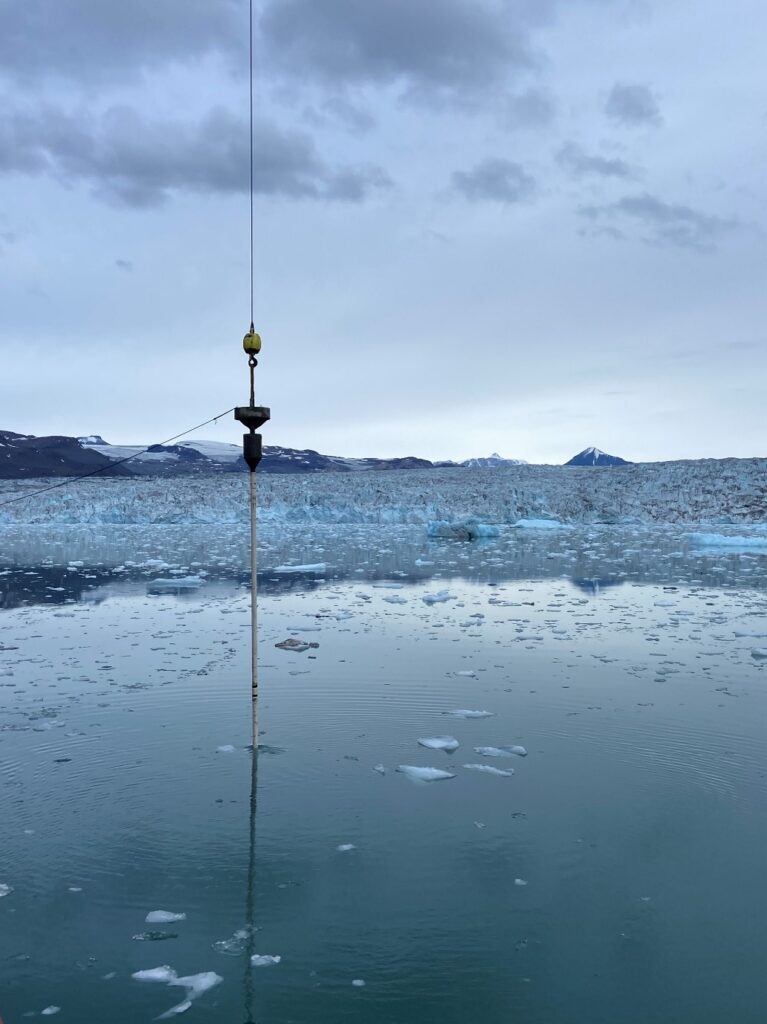
We have three methods to collect sediment cores, the gravity and piston cores for longer records (up to 10 m) and the multicore to collect 12 50 cm cores at one time.
Gravity core being deployed by the ice front
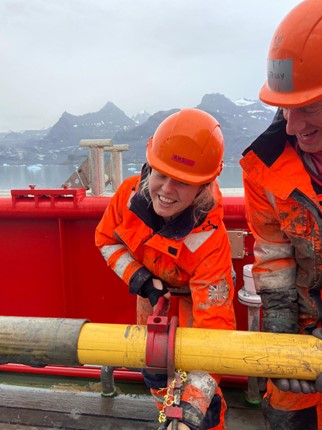
Once on deck, the yellow plastic liner containing the sediment within the longer gravity and piston cores needs to be cut into more manageable 1 m sections. We use a core cutter which is a blade on a ring to slice the liner open, then cut through the mud with a cheese knife. We put a cap on each end then label the sections.
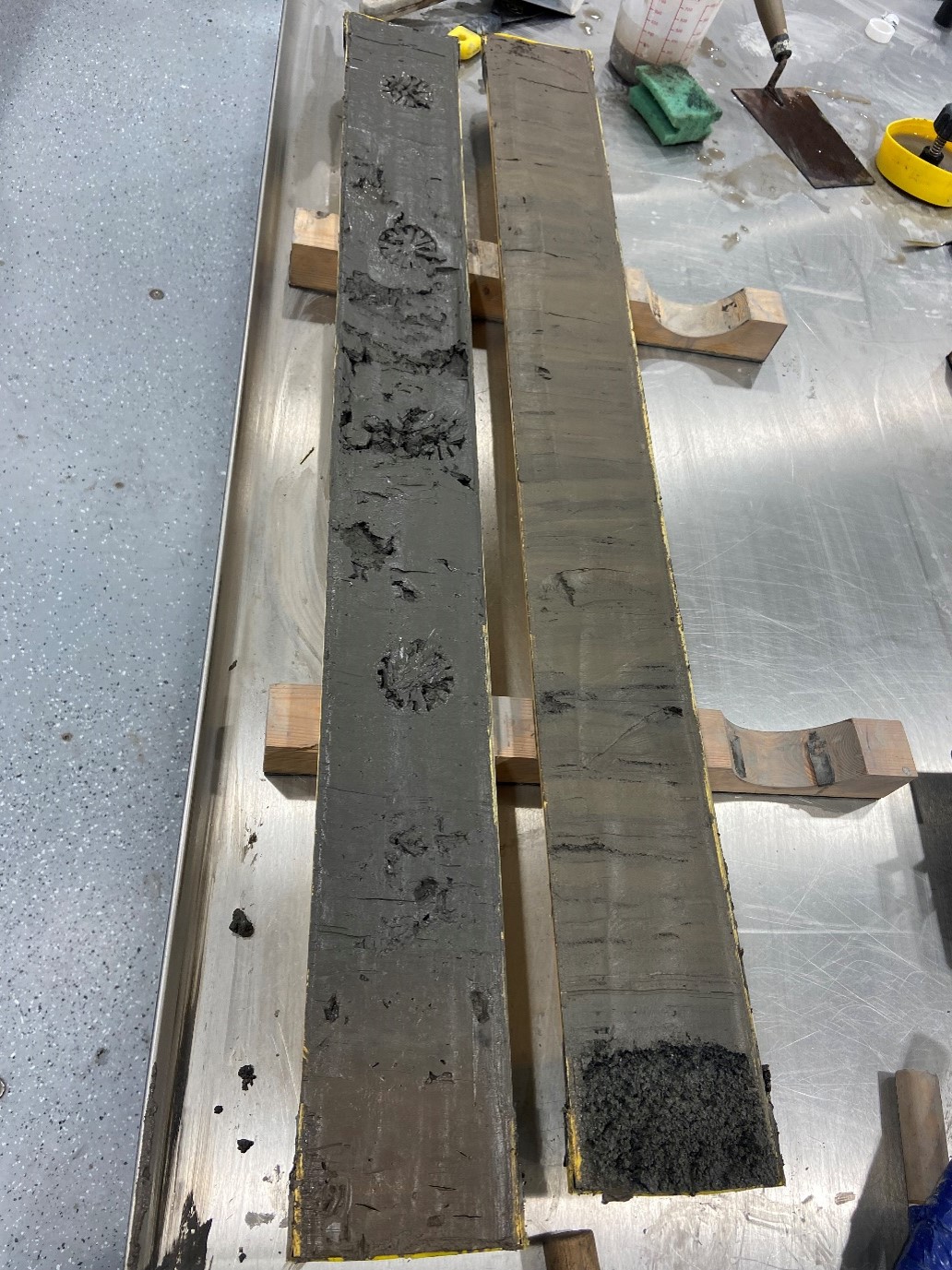
Core cuttingSplit sediment core with some interesting laminations and a gravely bottom
On nights when there are no coring deployments we would split open a core or two to log the sediment and take a few samples. This involves cutting lengthways along the liner before cutting through the sediment with cheese wire. This gives us an initial glimpse at the sediments that we have collected, and will help us to decide which cores are best suited for further analysis.
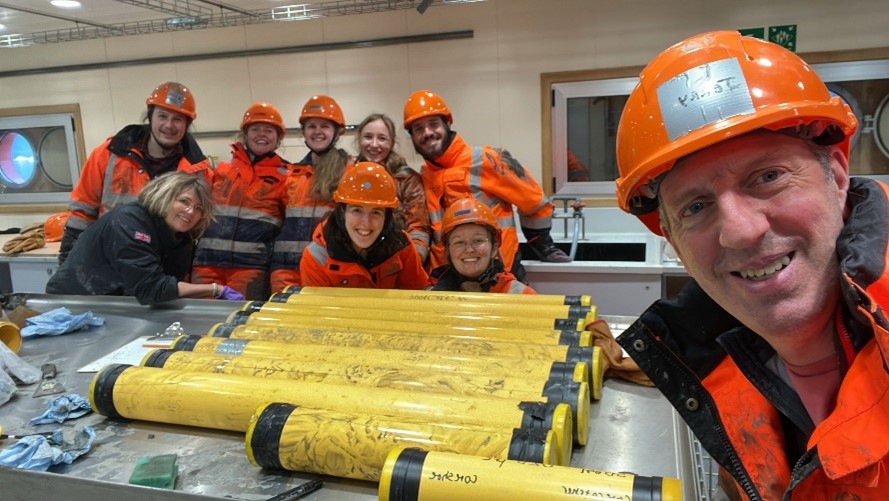
The coring team with our first 9 m core
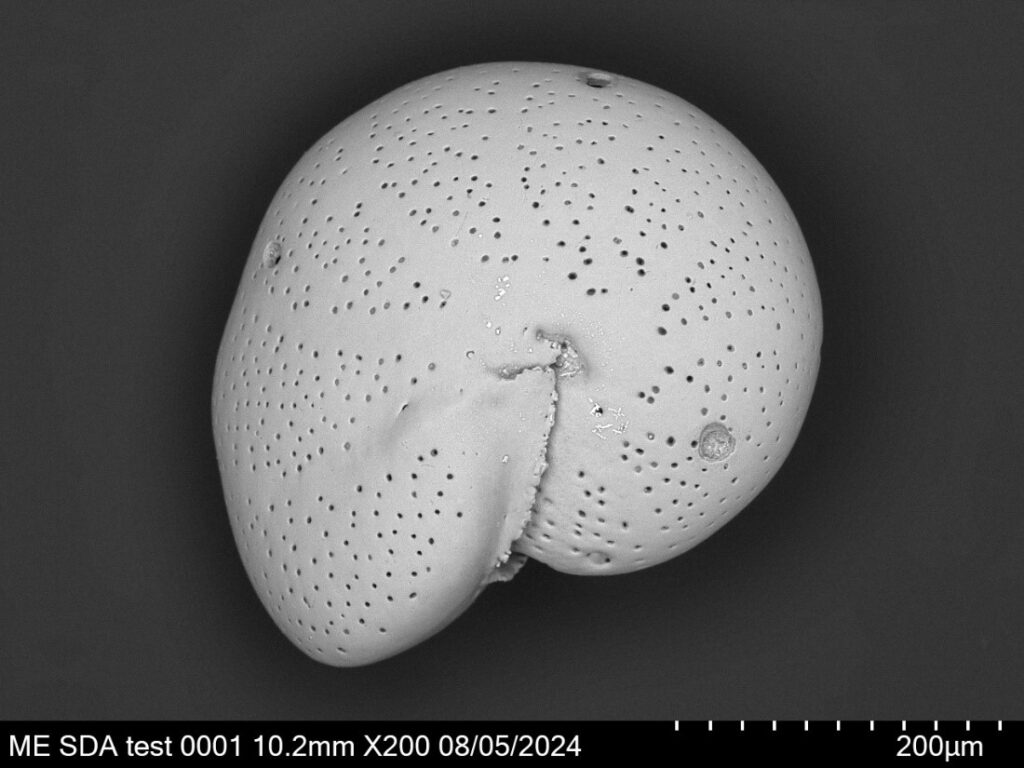
Once the core is open, we can sample for foraminifera (tiny shells from creatures that lived and died on the seafloor). We can identify and count the species of foraminifera under a microscope. Different species like to live in different water conditions, so we can use them to reconstruct relative changes to ocean conditions at the coring site through the Holocene.
SEM image of foraminifera Melonis Bareanus
Free time
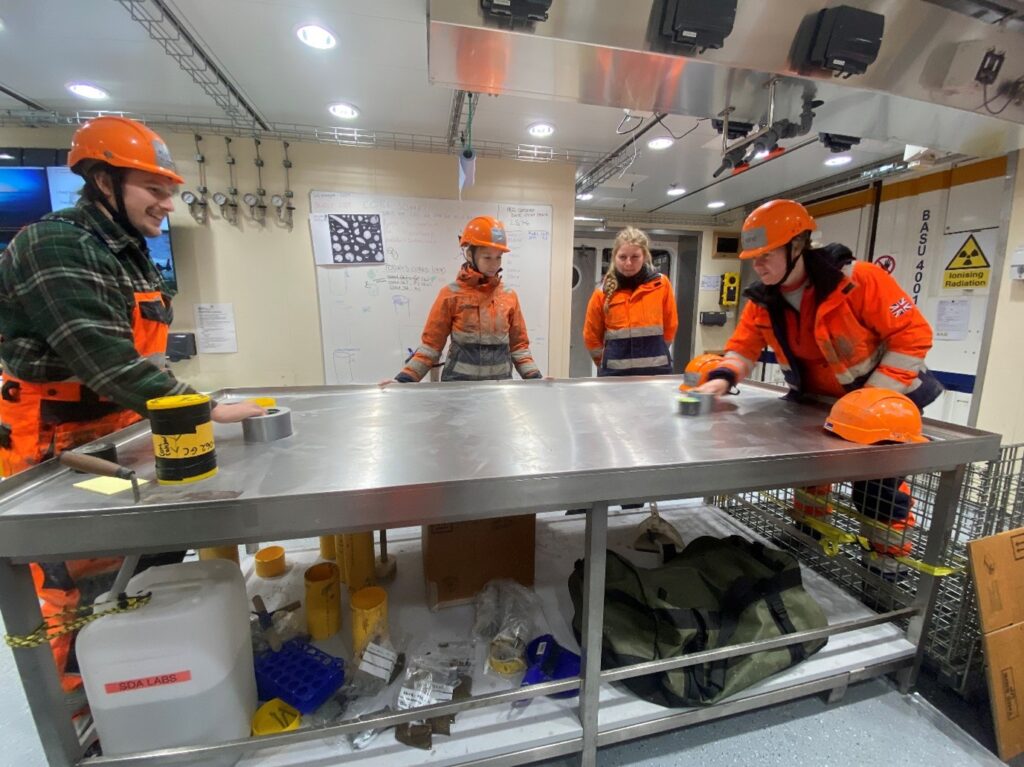
There is a fantastic community feel while on the ship which was fuelled by the weekly quiz, knot tying lessons, some small gym clubs were formed, and even a chat for the sauna (if you wanted to dump a bucket of freezing seawater on yourself first!). A lot of our free time was spent either in the bar or the day room watching movies or playing Mario Kart. If we want some fresh air we can go to the helideck or observation deck to take some pictures and do some whale or polar bear spotting. We even had the time to make up some games in the labs.
Discover more
Download our latest prospectus and college guide here.
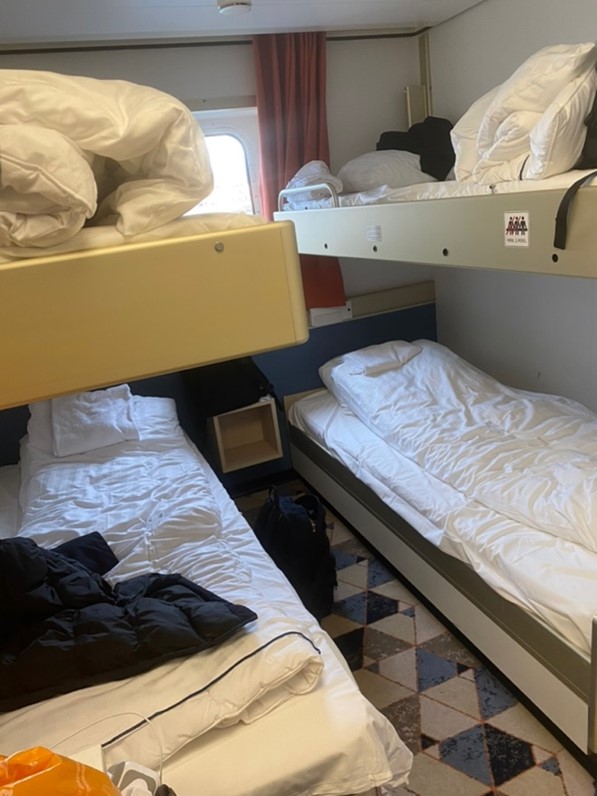
This diary begins on the Newcastle to Amsterdam ferry, where I am writing in our rather small cabin on the sixth deck. Having never been on an overnight ferry before, I must admit that the idea of sleeping in a small cabin whilst rocking on the water does feel a bit strange. However, I have come prepared with my sea sickness tablets, which seemed to have worked well so far, albeit the North Sea does seem fairly calm this evening. Most of our group seemed to have enjoyed the buffet on board the ferry, with plenty of options and different cuisines available. A particular highlight was the soft-serve ice cream that was available as a dessert – definitely pick vanilla over strawberry next time! The sea is fairly calm and I’m hoping I can get a good night’s sleep.
Friday
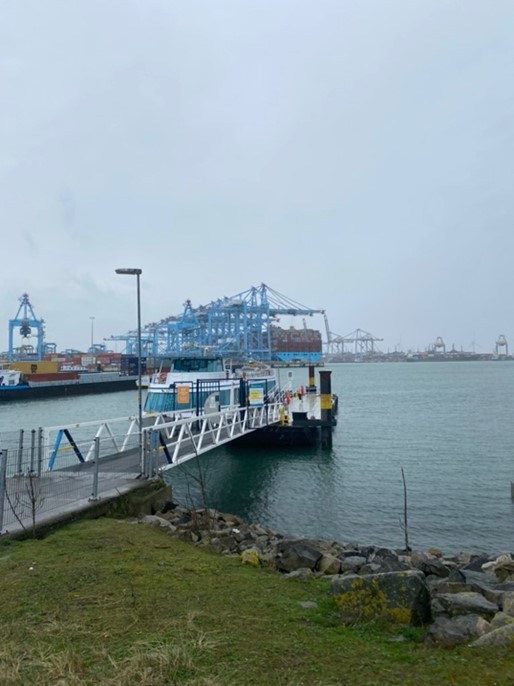
Today was jam-packed with activities! After waking up, my first realisation was that the sea was much choppier than the night before. After a hearty breakfast on board the ferry (with particularly nice bread!), accompanied by an extra sea sickness tablet, we finally arrived in Ijmuiden. Our coach met us at the ferry terminal, where we immediately made our way to the University of Technology at Delft. Here we visited the Green Village, where our guide talked us through the various innovations that had been developed for home and work spaces. However, for me, the highlight of the day was visiting the Port of Rotterdam, where we were taken on a tour of the port by boat. Our guide gave us information about the port and the functions of its different areas and was particularly useful in pointing out where the Porthos off-shore Carbon Capture Storage (CCS) project was located. A surprising sight at the port was the impressive HMS Prince of Wales aircraft carrier that was briefly visiting having come back from NATO exercises earlier in the month. After an exhausting day of events, we checked into our hostel, which had a quirky exterior design of yellow cubes tilting at different angles! The evening allowed us to explore the city somewhat, and a group settled for a pint (well, 500ml) of beer at one of the city centre’s many bars.
Our cabin on the ferryPort of Rotterdam
Saturday
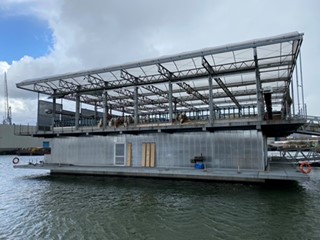
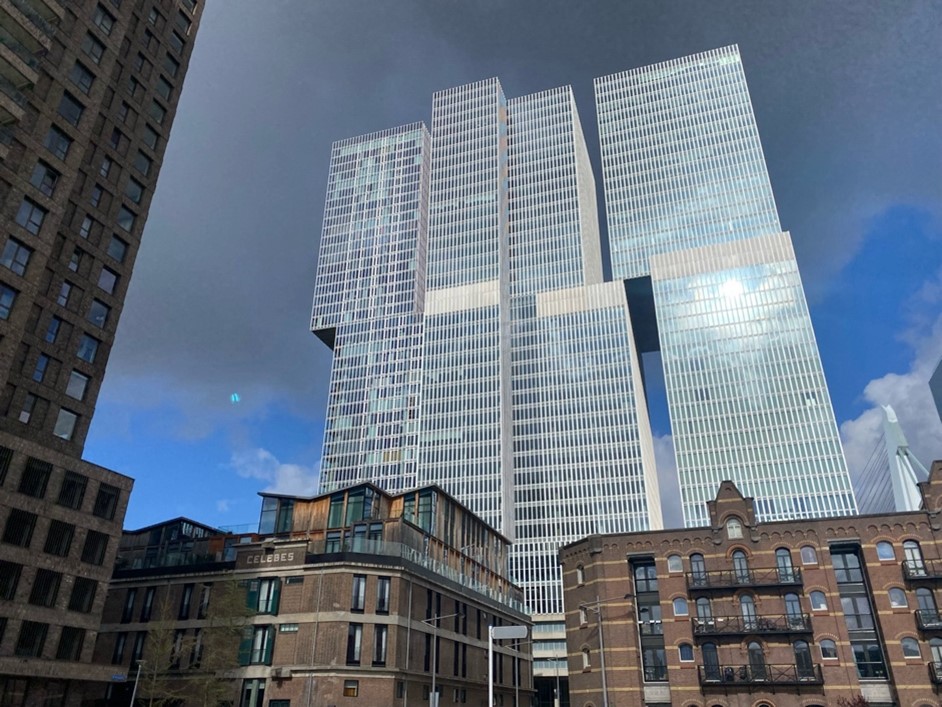
Our second day in Rotterdam began with a speedy breakfast as we dashed quickly off to the city’s unique mode of transport, the water taxi’s. These small yellow boats were really convenient at getting us right to the city centre, where we would meet our architect guide. During our tour we learnt more about the rather wacky architecture of the city, such as the Lego-esque De Rotterdam skyscrapers. Most of Rotterdam’s old historic centre was completely decimated by bombing during World War II, except for the Art Noveau Hotel New York, that once served as the departure point for Dutch emigrants heading to America. In my personal opinion, I haven’t been particularly fond of either the post-war brutalism nor the contemporary high-rises that make-up much of the city’s centre. Following our tour, we headed to the Maker’s District, where we given a talk by the volunteers at the Floating Farm, a self-sufficient farm built and floating on water that housed over 30 cattle at our time of visiting. Whilst it was an interesting concept, it did slightly feel like “tech for tech’s sake”, and some of our group questioned the ethics of housing over 30 cattle on a small grid beside the Port of Rotterdam. After a long-day, I went out for a bite to eat at one of the local burger restaurants, before settling down for the evening.
The floating farmThe famous “De Rotterdam” buildingA strange-looking building next to the Rotterdam architecture museum
Sunday
The day started more relaxed than the previous one as we headed leisurely towards Rotterdam’s architecture museum. The museum had a particularly interesting exhibition on Netherlands’ spatial planning, in which it displayed infographics of the past, present, and future plans for the Netherlands by architects and the government. In the afternoon, we split off into our project groups, with our group heading back to the central library right beside our hostel. With an interview with Porthos coming up the next day, we planned our line of questioning and divided responsibility for note-taking/asking questions. In the evening, we received a fascinating talk from an employee of Solar World, a company that provided small-scale solar energy solutions to neighbourhoods in Malawi and other African countries.
Monday
After an early breakfast at the hostel, we took a coach to TomatoWorld, a greenhouse and information centre funded by multiple different companies that develops innovative technology in the greenhouse tomato-growing sector. Entering the greenhouse was exactly like the feeling you get when stepping off a plane in a warm country, the temperature had risen about 10C to 15C! A particularly fascinating fact about TomatoWorld was that they utilised CO2 captured by industries in the Port of Rotterdam and fed it through pipes into the greenhouse to help the tomatoes grow. Following our tour at TomatoWorld, we briefly headed to the Innovation Dock, an old warehouse that was home to numerous projects, many of which were being carried out by students. However, our group left the warehouse early, as we needed to head on the metro across town to Porthos’ office in the north east of the city. We met our interviewees at Porthos, who spoke perfect English like everyone else in the Netherlands. They gave our group enlightening information about the role of CCS in the Netherlands’ energy and how the Porthos project came about. With our data gathered successfully, our group headed out to a pizza restaurant in Rotterdam to celebrate our findings.
Tuesday
After a hectic few days, today has been fairly chilled by comparison. Following a slow start, our group met downstairs in the hostel’s common area, which had plenty of workspaces. We started work on our presentation, designing the PowerPoint slides and writing scripts for the sections we had assigned ourselves. Some good news came at around lunchtime, as another company involved in the Porthos project, EBN, came back to us and said that they were available for an interview tomorrow. As their head office was in Utrecht, it meant seeing another city in the Netherlands! Our group had been slightly envious of the two groups studying urban mobilities, who had been to both Amsterdam and Utrecht in the last few days – but at least now we can also see a bit more of the country!
Wednesday
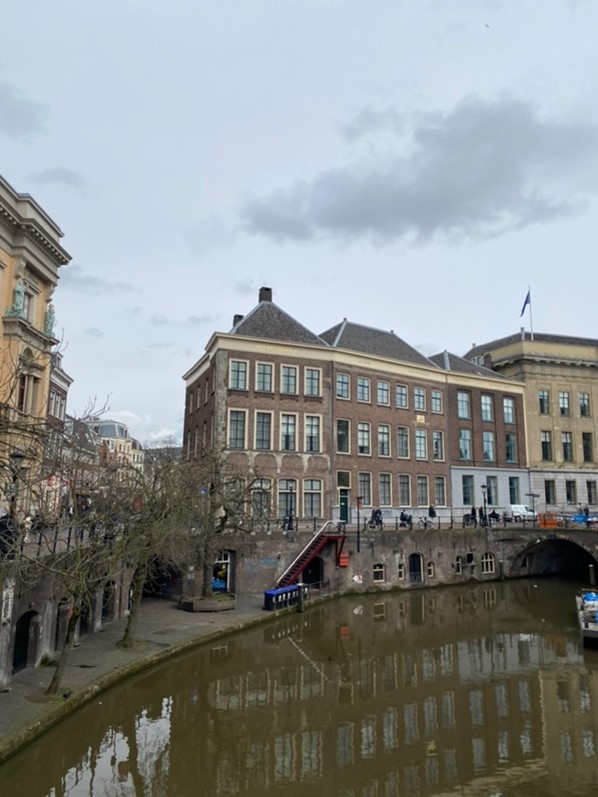
This morning we headed off on a train to Utrecht for our interview with EBN. Utrecht Central station was massive and really easy to navigate, and luckily EBN’s office was really nearby. Our interviewee was directly associated with the Porthos project and was particularly knowledgeable on the risks associated with the project and the technicalities of CCS. After our interview, we were able to explore Utrecht a bit more and find somewhere for lunch. The city was strikingly beautiful – with narrow streets and much more traditionally Dutch architecture. We found a really good Italian sandwich place selling huge cheese, salami and veg sandwiches for just €4! In the afternoon, we went to the university’s library, which we were able to enter as students. Something that I found very interesting was the amount of English being spoken by other students who were presumably studying at Utrecht University! We headed back to Rotterdam just before dinner, and as of the time of writing, have spent the evening working on the last touches of our presentation!
A great day spent in Utrecht
Thursday
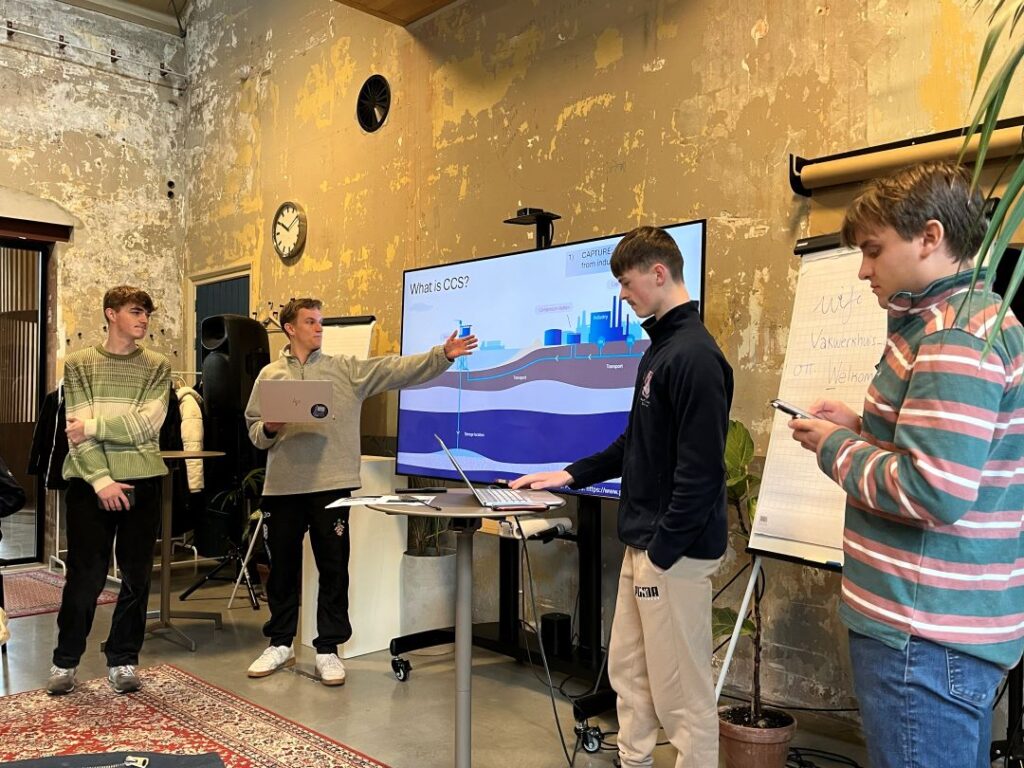
Our last day in the Netherlands! We headed this morning to where it all started, Delft, where we had booked a private room in a co-working space to conduct our presentations. We were up second, and I would be lying if I said I wasn’t a little nervous. However, our preparation from the last few days paid off massively, as we all finished thinking it had gone really well. I was impressed by the effort put in by the other groups as well, and particularly the clear and professional design of their PowerPoint slides. With the assessment out the way, we had a quick lunch at the co-working space, headed into Delft (another city with great architecture) for some snacks for the ferry and got on our coach back to IJmuiden. Although I was looking forward to getting back for some rest after a jam-packed trip in the Netherlands, I have to say that overall, the trip was great fun and I really enjoyed working with my team on our CCS project.
Discover more
See highlights from the field trip to Rotterdam here
If you are seeking a field trip that offers real-time examples of geographical concepts, the chance to experience a variety of rich cultures all within just one city, plus some fun on the side then I would highly recommend choosing the module ‘Chicago: Sites of Global Change’. It’s not just about the field trip; the lectures and seminars over the whole year cover fascinating themes and scholarly insights which will enrich your overall learning experience.
Why choose a module that has a field trip?
Geography stands out as a subject because it provides field trips where you can witness first-hand the concepts you’ve been studying all year. These trips also offer opportunities to conduct research on topics that truly interest you, thereby enhancing both your knowledge and research abilities. Yet, perhaps the most significant aspect is the chance to meet fellow students from your course whom you may not have crossed paths with otherwise. Sharing ideas and exploring a new city or location together fosters quick and meaningful connections—I’ve certainly formed lifelong friendships during my trip to Chicago!
My fieldtrip diary
Tuesday
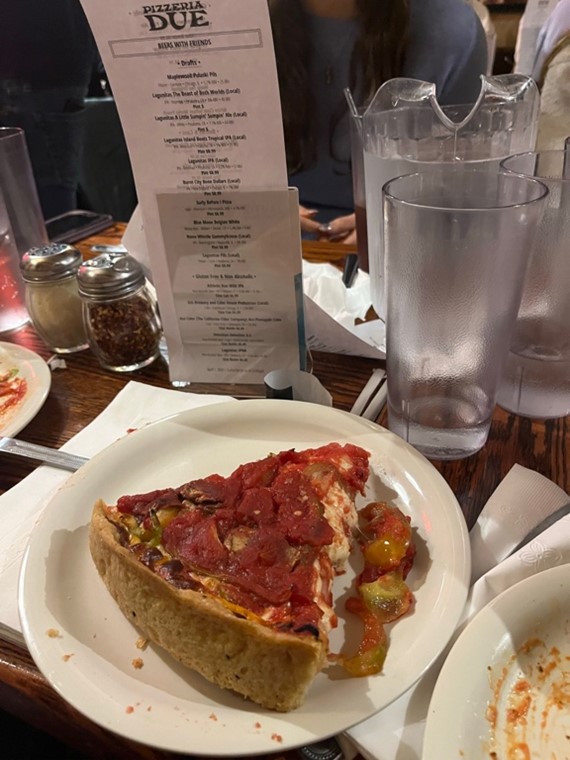
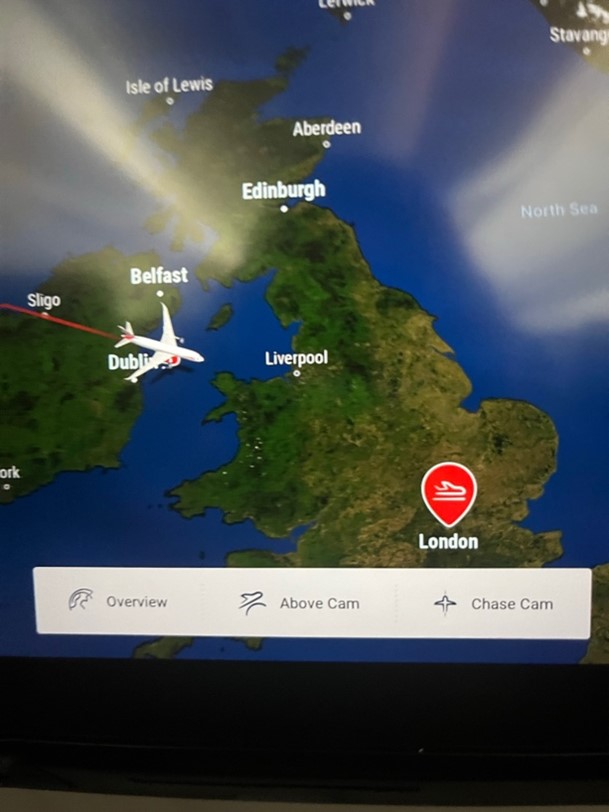
We got to Heathrow for our 11am flight just in time and checked in with our student registers, before making our way to Wetherspoons for our last English breakfast. The flight went very smoothly (the film selection was amazing) and we touched down in Chicago’s O’Hare Airport at around 4pm! We went directly to our hotel in the city centre passing American flags, McDonalds, and Targets on our way in. For our first night we had Chicago deep dish for the first time which had mixed reviews, but everyone managed to finish their huge portions of garlic bread, pasta and meatballs and thin crust pizza! After eating ourselves into a food coma we settled in our 4 bed dorm rooms (chosen by us) to try and sleep the jet lag off.
Chicago famous deep dish pizza and spaghetti and meatballs from Pizzeria Due
Then it was time for our first full day in Chicago! For our weeklong trip we had 3 days of activities that had been planned by our professors and teaching staff and then 4 days for our own individual research activities.
Wednesday
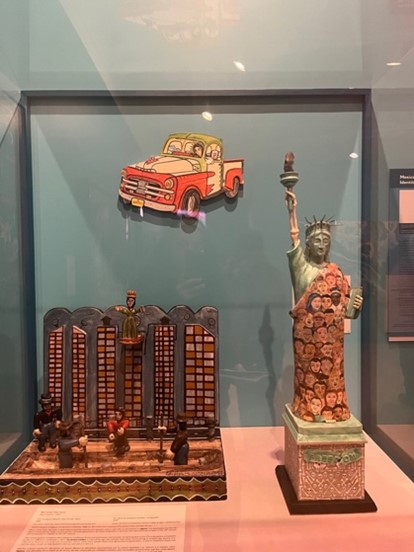
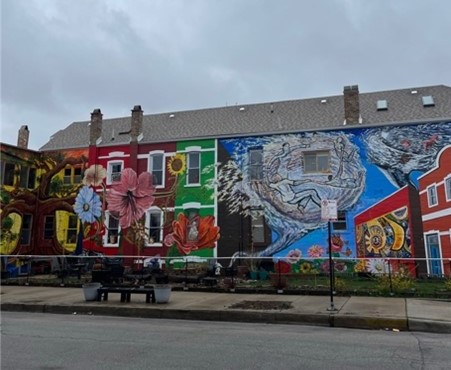
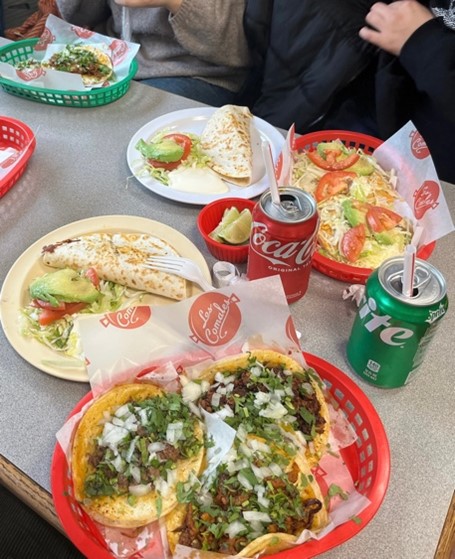
We started this day by getting on the ‘L’ which is Chicago’s public transit system, famous for being above the streets around the Loop (the centre of Chicago), eventually making it to Pilsen, a neighbourhood in the Lower West Side of Chicago. We had researched this area extensively in the module beforehand due to its unique rich Latino culture and beautiful murals, so being able to see it in real life was incredible. We got a guided tour of the National Museum of Mexican art before enjoying some authentic Mexican tacos and walking around the Pilsen neighbourhood which is becoming more and more gentrified. We even managed to stumble across the TV show ‘The Bear’ being filmed which was a highlight! We ended the day in Logan Square Library where we split into our groups, decided based on our research topics, to plan our own research days and get in touch with anyone in the city that we thought may be useful to speak to.
An art piece on Mexican immigration from the National Museum of Mexican Art in Pilsen A mural in Pilsen (an area famous for its Latinx influenced murals) Tacos from a restaurant in Pilsen called Los Comales (a local favourite)
Thursday
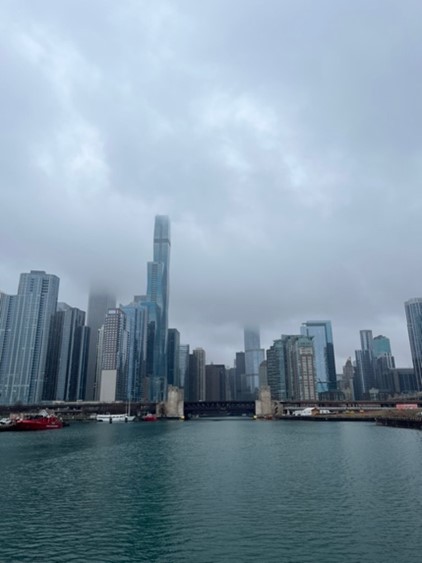
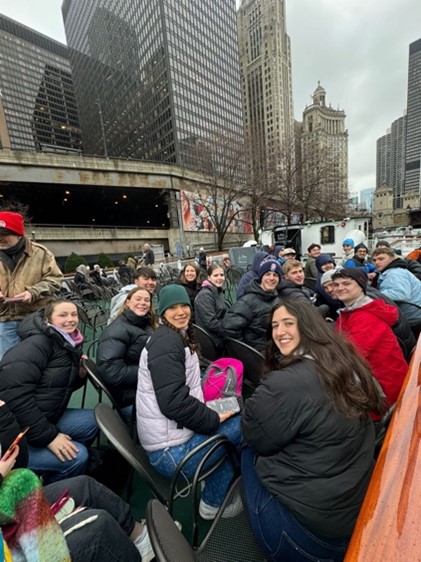
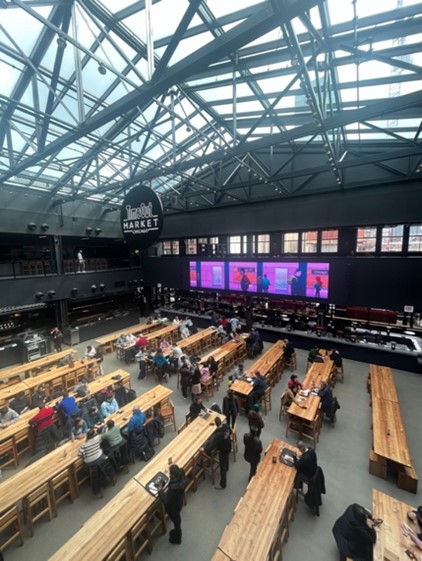
On Thursday, despite the rain and snow, we braved an open top boat tour which took us up and down the Chicago River with a tour guide who gave insights on the architecture and history of the most famous buildings in the city. We then got a tour (on foot), when it had stopped raining from Rachel Weber, a professor at University of Illinois Chicago (UIC) and author of the book “From Boom to Bubble: How Finance built the New Chicago”. A book which we had studied in the ‘Urban Governance and Neoliberal Chicago’ block of the module. Rachel gave us an updated version of her book with information on how the city’s downtown buildings were being utilized post-Covid. We ended the day with dinner at the famous Time Out market in Fulton Market where we got to speak to some UIC students about their own research.
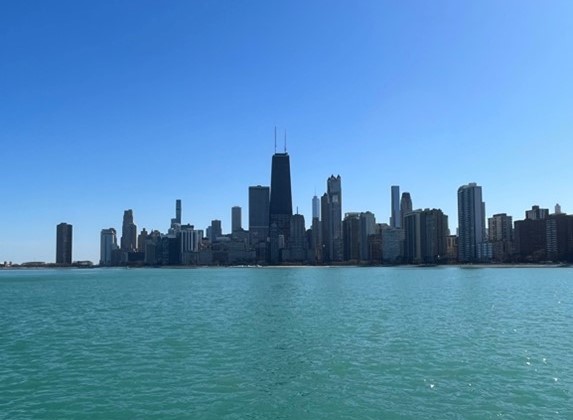
A view of the Chicago skyline from our boat tour Braving the rain during a boat tour of Chicago’s famous architecture The Time Out Market in Fulton Market where we had lunch one day
Friday
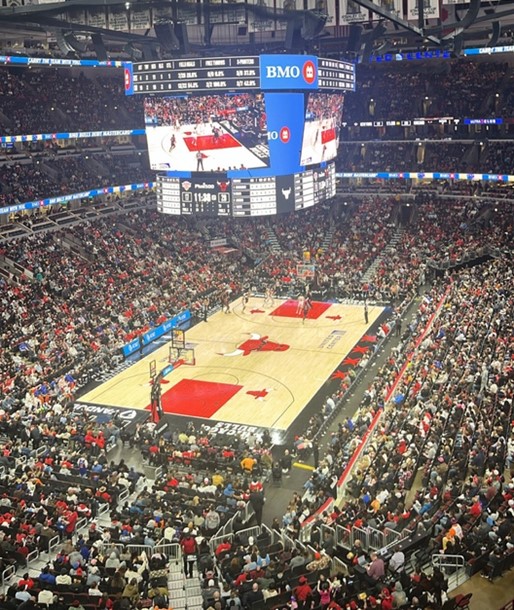
On the final day of our scheduled activities, we embarked on a tour of Chinatown, situated on Chicago’s south side. Our itinerary included a visit to the Chinese American Museum, which offered insights into Chinese American identity and the historical significance of Chinatown within the broader context of the city. We paused for lunch at an authentic Chinese restaurant, followed by some bubble tea, a first for some of us! We ended our day, by venturing to the magnificent Chicago Cultural Centre in the heart of the city, renowned for its striking architecture and hosting various art exhibitions and cultural events. In the evening, a handful of us fulfilled a long-standing dream by attending a Chicago Bulls basketball game – an unforgettable experience complete with energetic cheerleaders, spirited mascots, and t-shirt cannons!
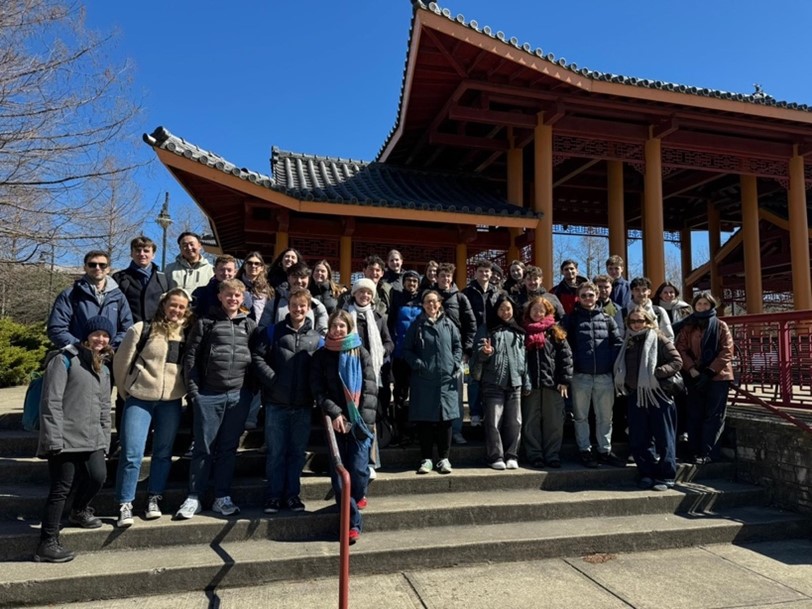
A Chicago Bulls vs New York Knicks match at the United CentreA group picture in Ping Tom Park in Chinatown
Saturday, Sunday, Monday
Over the weekend and into Monday, we carried out our own research, making each individual day unique! My group and I got involved with a litter picking initiative in Pilsen and got to speak to members of the city council and locals. These conversations led to an invitation to visit the City Council building where we conducted an interview with the Director of Housing and Real Estate, directly contributing to our research objectives. We also explored Chicago’s prominent green spaces, observed the final stages of construction of the Obama Presidential Centre and received a tour of the University of Chicago from students themselves. Each evening, we congregated at a restaurant to discuss our research findings and seek guidance from the teaching staff. Throughout our days, we diligently recorded our observations in field notebooks, providing valuable material for further reflection in following days.
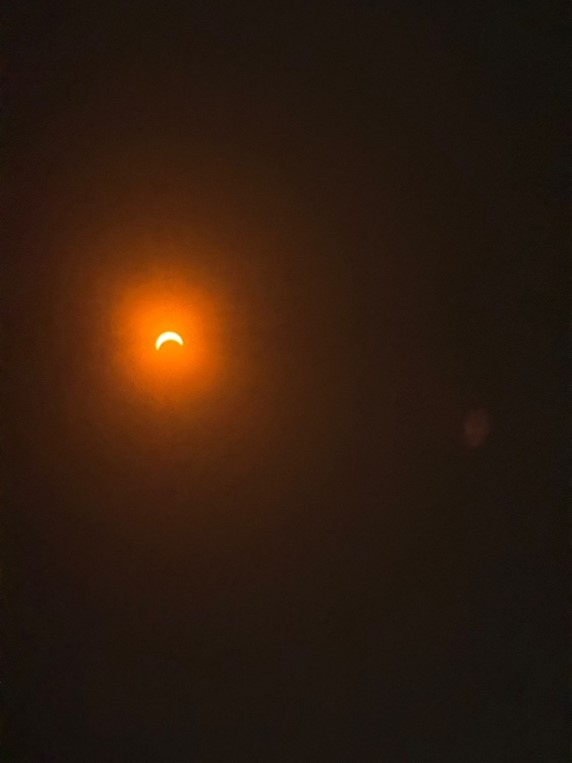
Remarkably, our visit coincided with the eclipse on Monday, April 8th, allowing us to witness the remarkable celestial event with special glasses, as the moon obscured 93.9% of the sun.
Looking up at the Solar eclipse (with special glasses) in Milennium ParkA picture of the solar eclipse taken through the special glasses
Tuesday
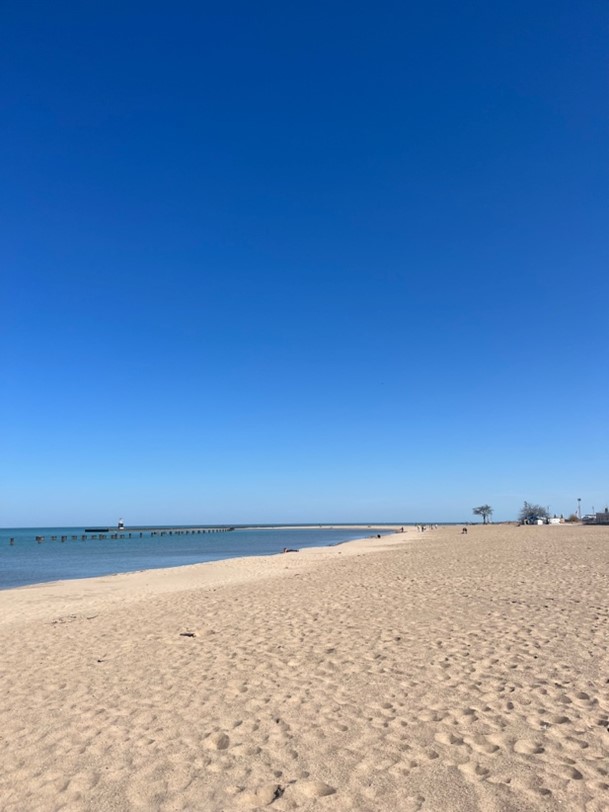
On our last day we had sunshine so before our 7-hour flight we decided to hit the beach and have a game of volleyball, tiring ourselves out before we started the long journey home.