Why I chose to study MA in Classics?

Years of studying at a classical lyceum shaped my love for antiquity and guided me towards a degree in Classics. As the end of my Bachelor’s at Royal Holloway approached, so did the deadlines for applying to Master’s programmes. Pursuing a joint honours degree in Classics and Modern Languages perfectly combined my interest in both languages and the classical world, and I wasn’t ready to leave academia just yet – was I ever going to be?

Extensive research into Master’s programmes at universities across the UK led me to Durham, as I found the right supervision for my area of interest. I already knew what I wanted to research, which certainly made my decision to commit to a Master’s programme easier and helped me navigate the process of choosing the right university. Of course, Durham’s reputation played a role in my decision to consider the university, but it was the department’s research that ultimately made my choice clear.

Now, as a second year PhD student, I cannot imagine choosing a different place. The outstanding professionalism, friendliness, and warm community of the Classics department led to my inevitable desire to continue my research – and what better place than the one I was already in?

Classics as a gateway to various career opportunities

The question that every Classics student hears, whether from a friend, relative, or stranger, once in a while is: “But what are you going to do with a Classics degree?” As annoying as that question might be, it is also a good opportunity to raise awareness of the usefulness of a Classics degree, because the options are endless. The analytical and linguistic skills gained from studying ancient texts are highly valued in many fields, making the degree more versatile than some might expect. These are transferable skills that go beyond academia, benefiting any career path.

Not convinced yet?

Choosing a degree is a really important decision, however, not the end of the world. It is not necessary to have a background in Classical studies to decide to pursue a degree in Classics. For example, I have friends from various humanities backgrounds who are drawn to the profound wisdom that antiquity offers.

Attending Open Days

Certainly, it might be very helpful to attend an Open Day at the university, where both professors and students from the department can share their perspectives and experiences, and also answer all the questions. In the end, the warm hospitality of everyone, and the inspiring atmosphere at Bailey’s amazingly situated department, will undoubtedly convince you to join Classics!

Discover more

Find out about the MA in Classics at Durham University here.

Find out more about postgraduate study here.

Find out how to visit us here.

Follow our students on Instagram, TikTok and YouTube.
From undergrad to postgrad: Why I stayed at Durham

Choosing to stay at Durham for my postgraduate (PGT) studies after completing my undergraduate (UG) degree was one of the best decisions I made. Having spent years at Durham, it felt like a natural choice to continue my academic journey in a place that had become my second home. The sense of community, beautiful surroundings, and strong academic support were huge factors, but the real reason was that I wasn’t done growing here. My undergrad years gave me a solid foundation, but I wanted to dive deeper into my field, and Durham’s postgraduate programmes were the perfect fit for that.

Durham had already given me so much during my undergraduate years. I had built strong relationships with professors and peers, and continuing that momentum was appealing. Staying here meant I could access the same fantastic support network, but with the added opportunity to specialise and explore my passions more fully.

The transition

The transition from undergrad to postgrad wasn’t without its challenges, but it was an exciting one. Postgrad life is more independent and self-directed, with a strong focus on research. As an undergrad, the structure was clear, with lectures, assignments, and tutorials guiding me. But postgrad? It’s all about taking charge of your own learning, diving into topics you truly care about. That sense of freedom made the experience incredibly rewarding.

One of the biggest changes was the academic expectations. While undergrad studies covered broad areas, postgrad allowed me to specialize and focus on what mattered most to me. This freedom meant I had to manage my time and workload more effectively, but the professors at Durham were incredibly supportive. They expect a lot from you, but they’re always there to help you meet those expectations.

Postgrad life also brought new experiences. I interacted with students from all over the world, each bringing unique academic and cultural perspectives. This diversity made seminar discussions richer and opened my eyes to new ways of thinking. It’s been a fantastic learning experience that goes beyond just academics.

Go for it!

If you’re thinking of applying to Durham for postgrad, my advice is simple: go for it! The transition might feel like a big step, but you’ll be supported every step of the way. Be ready to take more control over your learning, and don’t hesitate to reach out to professors – they are genuinely invested in your success and will help you with the transition.

Open days, research, and current students

To make sure Durham was the right choice for me, I attended open days and spoke with current students. I also did my own research into course structures, which gave me a good sense of what to expect. Durham’s reputation for academic excellence, combined with the friendly campus atmosphere, made my decision an easy one.

In the end, staying at Durham wasn’t just about comfort – it was about continuing to evolve, both academically and personally. It’s a place where you’re encouraged to push your boundaries, and the opportunities for growth are endless. If you’re on the fence, go for it – you’ll be glad you did!

Discover more

Find out more about postgraduate study here.

Chat with a student ambassador here.

Find out how to visit us here.

To find out more about student life in Durham follow our students on Instagram, TikTok and YouTube

Transitioning from undergraduate to postgraduate: my journey at Durham

From a bachelor’s degree to a master’s degree, the journey is full of both difficulties and rewards. One of the main differences that struck me was the higher expectations with academic output. The Master of Science (MSc programme) is more about the acquisition of knowledge; it is also about using the knowledge in real-world problems. Undergraduate studies require the students to take a more structured approach to learning, whereas postgraduate studies are orientated towards promoting critical thinking and practical application, especially in my Business Analytics field.

To begin with, the initial challenge I struggled with was the strictness of the postgraduate course. The workload was alright, but I had to be a lot more independent in learning. It wasn’t only about following instructions, but rather about thinking critically, casting doubts, and seeking new solutions. In particular, the peer-to-peer learning was the part that was the most prominent for me; projects in groups and workshops were central to the study process. When I attended lessons with my classmates, from various backgrounds, the different perspectives made lessons even better.

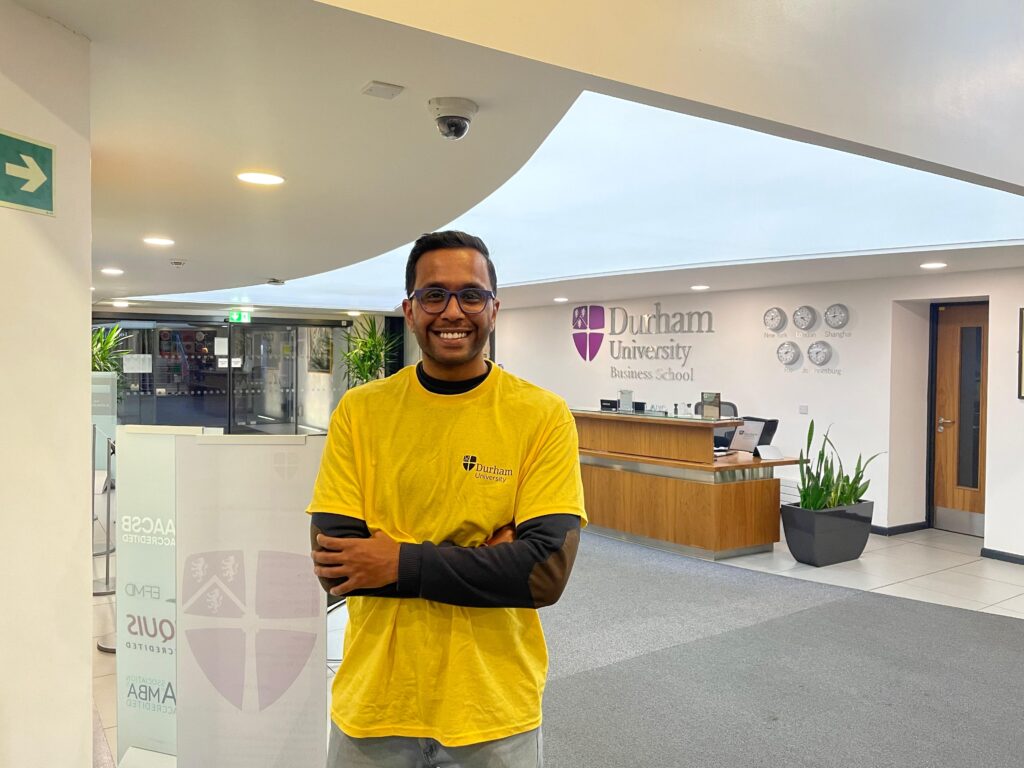
Standing in the Business School reception

Adapting to a new university and country

Moving from one university to another, let alone one in a different country, was a whole new world for me. When I did my Bachelor’s in India, the complete shift to the UK made me encounter a different type of delivering content to the student, as well as an academic culture that I was not familiar with. The teaching process in the UK is more orientated towards the discussion and research parts. The teachers of Durham are not only experts in their subjects but are also deeply engaged in the research that is ongoing. This is what helps to shape the content and create a dynamic curriculum. They foster a culture of critical interaction among the students – this empowers them to be more inquisitive.

The teaching method at Durham encourages collaboration between students and teachers in such a way that they not only learn in the classroom but also reveal the skills that will be of great help to them outside of the classroom. What they are trying to encourage in students is the learning of a subject without paying too much attention to the scores one gets in exams. As an illustration, I was very surprised when my professor elaborated extensively upon the subject matter that I had submitted and then invited me for a personal meeting.

Apart from education, fitting into life in Durham was a real puzzle to be solved. Different cultural and social conditions, a new town, was not all plain sailing, and it took some time to acclimatise to the rather icy weather and to understand some British social norms. However, even with the cultural mismatch, Durham, with such a thriving local community, made it possible to adapt to the new city. It has really proven to be a student-friendly city in which I have quickly made new friends, thanks to the system of collegiality.

Advice for prospective students

For anyone considering Durham for their postgraduate studies, my advice would be simple: take the leap. Durham is more than just an academic institution; it’s a place that encourages holistic growth. The curriculum is well-balanced, especially in courses like Business Analytics, where technical, business, and strategic aspects are seamlessly integrated. This not only makes you a well-rounded professional but also boosts your employability prospects.

When deciding on a university, it’s important to look beyond rankings and reputation. For me, the sense of community and the academic environment were decisive factors. Durham offers a space where you’re constantly learning – whether from professors, peers, or the vast array of resources available, both online and in the university’s libraries.

If I were to give prospective students one key piece of advice, it would be to be open-minded and embrace the student experience fully. Whether it’s academic discussions or extracurricular activities, Durham offers something for everyone, and there’s enough time for everything if you plan well.

Taking part in a fashion show

Final thoughts

In summary, transitioning from undergraduate (UG) to postgraduate (PG), especially at a prestigious institution like Durham, has been a transformative experience. The combination of academic rigour, a supportive community, and exposure to diverse perspectives has made my time here invaluable. My goal after completing my Master’s is to return to the workforce, ideally in analytics or retail, with a renewed sense of purpose and a deeper understanding of the business world.

To anyone still on the fence about applying to Durham, I can confidently say that this place has much more to offer than what meets the eye. It’s not just about getting a degree; it’s about making Durham your second home, a place where both your personal and professional growth are nurtured.

In one sentence: “Durham becomes more than just a place to study—it becomes home.”

Discover more

Read about Durham University Business School here.

Read about Postgraduate study at Durham here.

Create your own personalised prospectus here.

To find out more about student life in Durham, follow our students on Instagram, TikTok and YouTube